Puerto Rican
East Harlem
NYCHA towers and FDR Drive replaced the tenement grid that Puerto Rican and African-American families had built through the 1940s. Centro's archives and the Young Lords record what the clearance tried to erase.
1947–1970
The neighborhood the bulldozers met
By 1950 the area bounded by East 96th Street, East 142nd Street, Fifth Avenue, and the East River held roughly sixty-three thousand Puerto Ricans, the largest concentration on the mainland.1 The tenements between Park Avenue and the river held the barbershops, the botanicas, the Pentecostal storefronts, and the social clubs that new arrivals from Ponce, San Juan, Aguadilla, and Mayaguez had built up through two decades of migration. La Marqueta, the public market under the Park Avenue railroad viaduct between East 111th Street and East 116th Street, drew twenty-five thousand customers a day by 1940, four years after Mayor Fiorello LaGuardia opened it to bring the neighborhood’s pushcart vendors under a permanent roof.2
The New York City Housing Authority and the federally chartered Committee on Slum Clearance looked at the same blocks and saw something different. They saw a slum ready for demolition. Between 1948 and 1962 the two agencies, working with Robert Moses’s Triborough Bridge and Tunnel Authority and the New York State Division of Housing, cleared roughly a quarter of East Harlem’s pre-war tenement fabric and replaced it with a ring of public-housing superblocks.3 Samuel Zipp’s Manhattan Projects traces the fight over what the towers replaced and what they produced, from the James Weldon Johnson Houses of 1948 through the community revolt that stopped the agencies’ plans for further East Harlem clearance in the late 1960s.4
The Italian-American families who had dominated East Harlem from the 1880s through the 1930s had largely moved by the time the bulldozers arrived. The 1930 census recorded roughly eighty-nine thousand first-generation and second-generation Italian-Americans in the district, concentrated between East 96th Street and East 125th Street from Lexington Avenue to the river.5 Leonard Covello, the Italian-American educator who founded Benjamin Franklin High School on East 108th Street in 1934, documented the neighborhood’s schools, tenements, and parish life through the Covello Papers, now at the Historical Society of Pennsylvania.6 The Italian exodus to Long Island, Westchester, and the New Jersey suburbs opened the blocks for Puerto Rican and African-American families, who moved into the same tenements under the same landlords and under rent rolls the landlords no longer had any incentive to maintain. The record of who lived in the tenements the towers replaced runs through Covello’s files, through the Centro de Estudios Puertorriqueños, and through the oral histories the descendants of the displaced families have been collecting for forty years.7
The towers and the tenements they replaced
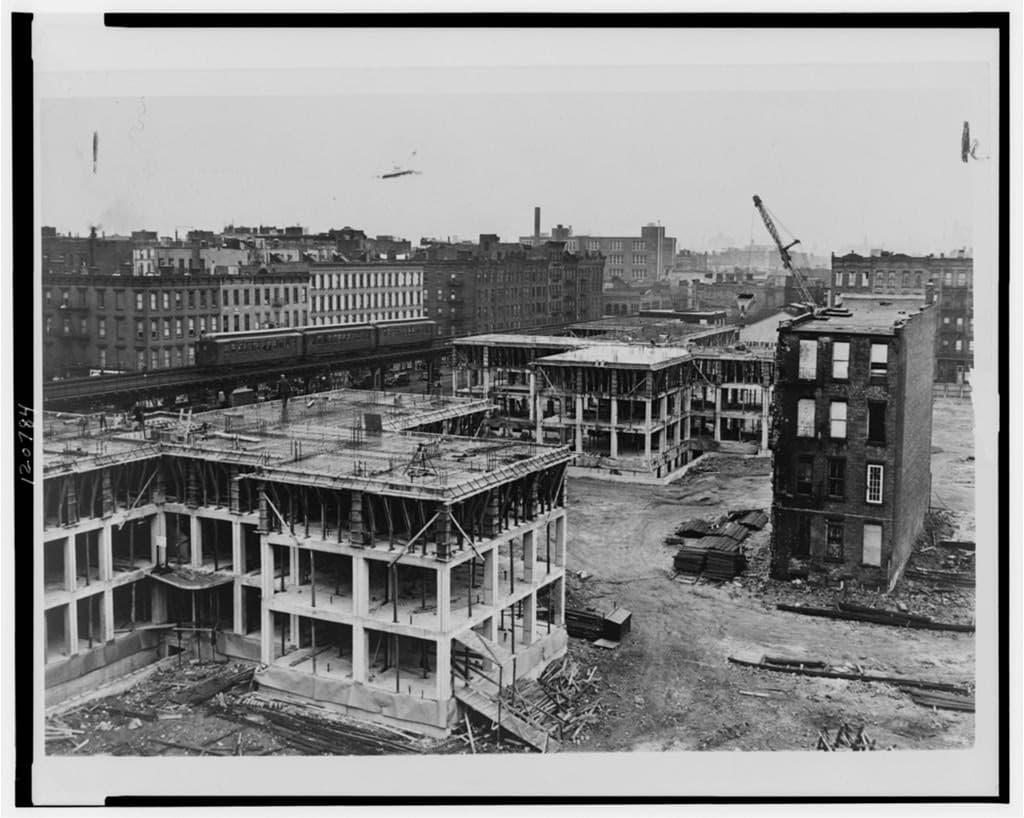
The James Weldon Johnson Houses opened on December 27, 1948, as the first full-scale public-housing project in East Harlem.8 Ten fourteen-story towers held 1,297 apartments across the blocks between East 112th Street and East 115th Street, Park Avenue and Third Avenue. The tenements the towers replaced had held brownstones, six-story walk-ups, bodegas, social clubs, and two parishes. The new project kept a fraction of the prior residential density and none of the street grid. Lawns, walkways, and parking surrounded the superblock slabs on which the buildings sat. The corner-store economy the tenements had supported had no physical place to reconstitute itself inside the project boundary.
The George Washington Houses followed on September 20, 1957, between East 97th Street and East 104th Street, Second Avenue and Third Avenue.9 Fourteen towers, most of them fourteen stories tall, carried 1,511 apartments on 20.82 acres. The George Washington Carver Houses, between East 99th Street and East 106th Street, Madison Avenue, and Park Avenue, began opening in 1955 and reached completion on January 31, 1958.10 Thirteen buildings on 14.63 acres held 1,246 apartments. Kahn and Jacobs, the firm that designed Carver, produced a pattern that NYCHA reused in half a dozen subsequent projects.
The Thomas Jefferson Houses opened on August 28, 1959, between East 112th Street and East 115th Street, First Avenue, and the FDR Drive.11 Ten buildings on approximately eight acres. The Taft Houses, between East 112th Street and East 115th Street, Fifth Avenue, and Madison Avenue, followed in 1962.3 The five projects together cleared more than seventy acres of pre-war tenement grid and resettled the residents who wanted to return, along with thousands of new families from the waiting list, into high-rise slabs that the planners marketed as light, air, and modern sanitation. The agencies published the before-and-after photographs in their annual reports. The photographs showed the tenements at their worst, with garbage piled in the airshafts, and the towers at their best, with children playing on mowed lawns. The photographs did not show what the projects subtracted. They did not show the lost churches, the lost bodegas, the lost social clubs, or the neighbors the clearance had scattered to the Bronx, to Brooklyn, and to the waiting lists of projects the agencies had not yet built.
By 1965 roughly a quarter of East Harlem residents lived in public housing.3 NYCHA’s East Harlem inventory had grown to one of the densest concentrations of public housing in the United States. The projects shared a common tenant composition. Most residents were Puerto Rican or African-American. Most were working-class. A substantial share of the adults held service-sector, factory, hospital, or municipal jobs. The project boundaries shaped electoral districts, school catchments, precinct maps, and the Democratic Party’s East Harlem clubhouse system for the rest of the century.
FDR Drive and the loss of the water
The FDR Drive along the East River had cut the lower stretches of East Harlem off from the waterfront by 1942, when the last section of the original boulevard between East 34th Street and East 49th Street opened.12 The northern segments through East Harlem, up to East 125th Street, proceeded in stages through the 1940s. The Harlem River Drive extension, which began construction in 1947 just north of the Triborough Bridge, reached substantial completion through the 1950s, with successive segments from East 125th Street to East 165th Street opening between 1951 and 1962.13
The drive took blocks that had held waterfront tenements, oyster houses, small manufacturing, and the ferry slips that had served the neighborhood’s commuters since the nineteenth century. The elevated sections, the on-ramps, and the retaining walls consumed parcels the agencies did not need for the roadway proper. The Triborough Bridge approach ramps, which crews completed in 1936 and expanded through the postwar period, had already severed the street grid at East 125th Street. The drive’s construction did not displace as many residents as the housing clearances, because the waterfront blocks were already thin, but the drive erased the neighborhood’s functional relationship to the water. East Harlem children who had swum off the East River piers into the 1930s grew up into East Harlem children who looked at the water through six lanes of concrete and could not reach it.
The drive’s construction coincided with the housing clearances because the same political arithmetic produced both. Robert Moses chaired the Triborough Bridge and Tunnel Authority, the Mayor’s Committee on Slum Clearance, and the parks department simultaneously through the postwar decades. Moses drew up the East Harlem housing and highway maps together. The housing towers sat inland from the drive. The drive carried the commuters from the new Westchester and Connecticut suburbs past the towers. The towers housed the displaced residents. The sequence fit together in the planning documents the Committee on Slum Clearance submitted to the federal government in support of Title I funding through the 1950s.4
East Harlem, El Barrio, grew as the largest Puerto Rican community on the mainland United States through the 1940s and 1950s. The New York City Housing Authority and the Committee on Slum Clearance cleared tenement blocks for public-housing towers between 1948 and 1962. FDR Drive cut the waterfront away in stages through the 1950s. The Young Lords, the East Harlem Tenants Council, and the Centro de Estudios Puertorriqueños preserved the record the clearance tried to erase.
The map shows East Harlem, El Barrio, La Marqueta, 1936 to present, George Washington Carver Houses NYCHA, James Weldon Johnson Houses NYCHA, 1948, Thomas Jefferson Houses NYCHA, 1959, El Museo del Barrio, 1969 to present, 125th Street rezoning corridor, 2008 onward, and FDR Drive / Harlem River Drive, East Harlem segment.
- East Harlem, El Barrio
- La Marqueta, 1936 to present
- George Washington Carver Houses NYCHA
- James Weldon Johnson Houses NYCHA, 1948
- Thomas Jefferson Houses NYCHA, 1959
- El Museo del Barrio, 1969 to present
- 125th Street rezoning corridor, 2008 onward
- FDR Drive / Harlem River Drive, East Harlem segment
Urban Renewal Atlas, illustrative coverage.; La Marqueta under the Park Avenue railroad viaduct.; NYCHA 1955 to 1958.; NYCHA 1948, the first full-scale East Harlem project.; NYCHA 1959.; Community-founded museum on Fifth Avenue.; Department of City Planning rezonings of 2008 and 2017.; FDR Drive alignment along the East River..
The Young Lords and the garbage
The destruction did not proceed unopposed. The East Harlem Tenants Council, organized in the late 1950s and active through the 1960s, contested rent increases, code violations, and the relocation terms the Committee on Slum Clearance offered to displaced tenement residents. The United Bronx Parents, the Puerto Rican Forum, and the Real Great Society organized across East Harlem and the South Bronx through the middle of the decade. By 1969 a new formation had arrived.
The Young Lords began as a Chicago street gang in the late 1950s and reorganized in New York in July 1969 as a revolutionary political party that took the Black Panther Party as its model.14 Felipe Luciano, Juan Gonzalez, Pablo Guzman, Iris Morales, Denise Oliver, Mickey Melendez, and Juan Ortiz led the New York chapter. The Lords took East Harlem as their base and walked the neighborhood door to door in the weeks before their first public action.
The first action was the Garbage Offensive. The sanitation department collected garbage in East Harlem on a schedule so much thinner than the schedule it ran in the white neighborhoods south of 96th Street that trash piled in airshafts and at curbs for weeks at a time. On July 27, 1969, the Young Lords and several hundred East Harlem residents dragged the uncollected garbage into the middle of Third Avenue and set it on fire.15 The Lords repeated the action every Sunday through August. The sanitation department increased its East Harlem service within weeks. The Lords drew an explicit political conclusion from the response. The city’s indifference had a precise weight. Sufficient counter-weight moved it.
The Lords’ 13 Point Program and Platform, drafted by Gonzalez and Guzman and published in October 1969, set out the organization’s full agenda.16 Self-determination for Puerto Ricans on the island and on the mainland. Community control of institutions. Bilingual education. Women’s liberation inside the movement and outside. An end to police brutality. Health care as a right. The program named East Harlem’s conditions as the local expression of a colonial relationship between the United States and Puerto Rico, and it named East Harlem’s organizing as part of a larger anti-colonial project.
On December 28, 1969, the Young Lords occupied the First Spanish United Methodist Church on the corner of East 111th Street and Lexington Avenue.17 The church’s pastor had refused the Lords’ request to use the building for a free breakfast program for children, a clothing drive, and a liberation school. The Lords entered during a Sunday service, barricaded the doors, and renamed the building the People’s Church. For eleven days, from December 28, 1969, through January 7, 1970, they ran the programs the pastor had refused, along with a day-care center, a health clinic, and political-education classes. Police arrested the occupiers on January 7. The charges did not survive the first appearance. The Lords had demonstrated that a contested institution passed, for eleven days, into community hands.
On July 14, 1970, at 5:15 in the morning, one hundred and fifty Young Lords and allies entered Lincoln Hospital in the South Bronx.18 The hospital, which sat in a collapsing nineteenth-century building, served a predominantly Puerto Rican and African-American patient population under conditions the Lords documented with photographs, patient testimony, and maternal-mortality statistics. The occupiers announced a set of demands: door-to-door preventive health services, patient-staff oversight of hospital operations, a detoxification program on the acupuncture model, and construction of a new hospital facility. The occupation lasted twelve hours. Police cleared the building. Two Lords faced charges that the prosecutor dropped by the end of the night. The city opened the new Lincoln Hospital in 1976. The acupuncture detoxification program the Lords launched in 1970 continued for decades under the People’s Drug Program and the later Lincoln Detox.
The Lords’ organizing coincided with parallel Puerto Rican formations across the city. El Comité-MINP, which organizers founded on the Upper West Side in June 1970, led Operation Move-In, a two-year occupation of vacant housing stock that placed more than two hundred families in buildings the Urban Renewal Administration had cleared for demolition.19 The Puerto Rican Socialist Party, the Armed Forces of National Liberation on the clandestine wing, and the pro-statehood Puerto Rican Legal Defense and Education Fund each drew members from East Harlem and each took positions on the neighborhood’s housing, education, and health-care politics. The Centro de Estudios Puertorriqueños, which the City University of New York founded in 1973 and which Hunter College now houses, gathered the documentary record the movements generated as they generated it.20
The Mayor’s Advisory Committee on Urban Renewal had proposed a large-scale East Harlem plan through the middle of the 1960s. The plan called for further superblock clearance, additional public housing, and shopping-center construction along 125th Street and along Third Avenue. The community formations the Garbage Offensive and the church occupation had built refused the clearance. The Architects’ Renewal Committee in Harlem, a community design center that volunteers founded in 1964 and that J. Max Bond Jr. led from 1967, produced a 1968 counter-plan called the East Harlem Triangle Plan, which proposed low-rise infill, commercial rehabilitation, and resident-controlled redevelopment for the triangle between East 125th Street, Park Avenue, and the Harlem River.21 ARCH’s plan did not win adoption in full. The city’s clearance plans, however, did not proceed either. The block-by-block bulldozer campaigns that NYCHA and the Committee on Slum Clearance had pursued from 1948 through 1962 slowed and, by the end of the 1960s, effectively stopped. The community resistance produced the halt. The official record attributes the halt to federal funding changes, to the 1964 shift in Title I policy, and to the 1968 Housing and Urban Development Act. The official record understates the community resistance.
Displacement after the bulldozers
The clearance did not end when the bulldozers stopped. A second wave arrived through the market. The 125th Street rezoning that the Department of City Planning approved in April 2008 allowed towers of up to thirty stories on blocks the prior zoning had restricted to low-rise commercial use. The rezoning covered the corridor through Central Harlem and East Harlem together, with the East Harlem blocks between Fifth Avenue and Park Avenue among the most affected. Local analysts documented a sharp acceleration in displacement pressure after 2008, with independent businesses losing their leases and long-term residents receiving buyout offers their landlords backed up with harassment campaigns.22
The East Harlem rezoning of November 2017, which the City Council approved after a contentious public review, extended the 2008 pattern across an additional ninety-six blocks. The rezoning allowed heights up to 335 feet along Third Avenue, Second Avenue, and East 125th Street and established a mandatory inclusionary housing requirement. The advocates who had negotiated the plan pointed to the affordable set-aside as the price of getting anything from the Department of City Planning. The residents who lost their apartments during the subsequent construction cycle pointed to what the set-aside had not done. The Municipal Art Society of New York published a 2017 analysis that projected the rezoning would displace between twenty-eight hundred and four thousand rent-regulated units over ten years.23
NYCHA’s East Harlem portfolio, which now holds roughly eight thousand apartments across Johnson, Washington, Carver, Jefferson, Taft, and several smaller projects, entered a period of sustained disinvestment through the 1990s and 2000s. Federal funding covered a shrinking share of operating expenses. Capital needs accumulated. By 2015 the NYCHA capital backlog across the entire agency exceeded seventeen billion dollars, with a substantial portion concentrated in the East Harlem projects. Residents lived with lead paint, mold, rodent infestations, elevator failures, and heating outages the agency did not have the funds to fix. The Permanent Affordability Commitment Together, the NYCHA conversion program that moves project management to private partners under Section 8, has moved several East Harlem developments into private-partner hands since 2018. Tenant organizers have contested the conversions on the grounds that they transfer long-term control away from residents and toward landlords whose incentives track the market rather than the lease.
The archive the neighborhood built
The record of what East Harlem was, and what the clearance took, survives because the descendants of the displaced families preserved it.
The Centro de Estudios Puertorriqueños at Hunter College holds the largest archive of stateside Puerto Rican history in the United States. Centro’s collections include the Justo Marti Photographic Collection, which carries more than thirty thousand negatives of Puerto Rican and Latino life in New York from the 1940s through the 1980s, with heavy coverage of East Harlem’s social clubs, parish festivals, political rallies, and family gatherings.24 Centro’s East Harlem papers include the records of the East Harlem Tenants Council, the Puerto Rican Forum, the Young Lords newspaper Palante, and dozens of family papers that East Harlem residents donated across five decades. The collections sit in the Silberman Building on East 119th Street, one block from the Johnson Houses and three blocks from the former site of the First Spanish United Methodist Church. Researchers can consult the finding aids at https://centropr.hunter.cuny.edu/ and the physical collections by appointment.
The NYC Municipal Archives hold the Committee on Slum Clearance reports, the NYCHA project files, and the tax photographs that document the tenements the clearance removed. The Committee on Slum Clearance papers run to more than three hundred linear feet. The NYCHA records include the site selection studies, the relocation plans, and the tenant correspondence that document what the agency told residents they were getting and what the residents found when they moved in.25 The New York Public Library’s tax photographs, which archivists digitized from the 1940 survey and the 1980s resurvey, carry a street-level visual record of the pre-clearance blocks that researchers and descendants use to reconstruct the addresses the Committee on Slum Clearance removed from the map.
Johanna Fernandez’s The Young Lords: A Radical History, which the University of North Carolina Press published in 2020, constitutes the most complete documentary account of the movement the Lords built. Fernandez worked through Centro’s holdings, the Municipal Archives, and a police surveillance file that she obtained after a decade-long Freedom of Information Law request. The book won the Liberty Legacy Foundation Award, the Frederick Jackson Turner Award from the Organization of American Historians, and the American Book Award from the Before Columbus Foundation in 2021.14 Arlene Davila’s Barrio Dreams: Puerto Ricans, Latinos, and the Neoliberal City, which the University of California Press published in 2004, carries the ethnographic account of East Harlem’s shift from urban-renewal target to Empowerment Zone site and gentrification front.26
Samuel Zipp’s Manhattan Projects traces the urban-renewal fight across four sites, of which East Harlem is the most sustained. Zipp drew on the Committee on Slum Clearance papers, the Robert Moses papers at the New York Public Library, and the East Harlem Tenants Council records at Centro. His chapter on East Harlem establishes the chronological sequence that the present essay follows.4
The living organizations that carry the record into the present include El Museo del Barrio on Fifth Avenue, which community artists founded in 1969 and which now ranks among the country’s principal Latino museums; Taller Boricua, the artists’ collective in the Julia de Burgos Latino Cultural Center on Lexington Avenue; the East Harlem Preservation organization; the Community Service Society of New York; and the Association for Neighborhood and Housing Development’s East Harlem chapter. The East Harlem Neighborhood Plan, which Speaker Melissa Mark-Viverito’s office published in February 2016 as a community-authored counter to the city’s rezoning framework, remains the reference document for present-day organizing.27
The clearance took blocks, churches, businesses, and families. The clearance did not take the record. The record sits in the Silberman Building, in the Municipal Archives at 31 Chambers Street, in the NYPL’s tax-photo database, in Centro’s oral-history tapes, in the stacks at UNC Press and the University of California Press, and on the walls of El Museo del Barrio. The descendants of the displaced families maintain that record and continue to build it. The rezonings of 2008 and 2017, the NYCHA disinvestment, and the new waves of market-rate development proceed against a neighborhood that knows its own history in detail. The knowledge is not a guarantee against further displacement. The knowledge is the ground on which East Harlem contests what the next clearance would try to take.
Footnotes
-
Library of Congress, “In Spanish Harlem,” Classroom Materials. https://www.loc.gov/classroom-materials/immigration/puerto-rican-cuban/in-spanish-harlem/ ↩
-
Public Markets NYC, “La Marqueta.” https://publicmarkets.nyc/la-marqueta ↩
-
Skyscraper Museum, “Housing Density: Harlem.” https://www.skyscraper.org/housing-density/wp-content/uploads/sites/3/2019/06/interactive/Harlem.html ↩ ↩2 ↩3
-
Samuel Zipp, Manhattan Projects: The Rise and Fall of Urban Renewal in Cold War New York, Oxford University Press, 2010. ↩ ↩2 ↩3
-
Italian Harlem, historical overview. https://atjg64.tripod.com/italianharlem.html ↩
-
Historical Society of Pennsylvania, “Leonard Covello and the History of East Harlem.” https://hsp.org/education/unit-plans/immigration-and-cultural-diversity-in-east-harlem/leonard-covello-and-the-history-of-east-harlem ↩
-
Centro de Estudios Puertorriqueños, Hunter College, Collections. https://centropr.hunter.cuny.edu/ ↩
-
Library of Congress, “James Weldon Johnson Houses covers from 112 to 115 St., Park to 3rd Ave.,” World-Telegram photo by Al Aumuller, 1948. https://www.loc.gov/item/98508086 ↩
-
New York City Housing Authority, “Washington Houses” development page, completion September 20, 1957. https://www.nyc.gov/site/nycha/about/developments/manhattan.page ↩
-
Carver Houses, Wikipedia. https://en.wikipedia.org/wiki/Carver_Houses ↩
-
Jefferson Houses Tenant Association, “About Us.” https://jeffersonhouses.com/about-us/ ↩
-
NYC Roads, “FDR Drive.” http://www.nycroads.com/roads/fdr/ ↩
-
Harlem River Drive, Wikipedia. https://en.wikipedia.org/wiki/Harlem_River_Drive ↩
-
Johanna Fernandez, The Young Lords: A Radical History, University of North Carolina Press, 2020. ↩ ↩2
-
History.com, “When the Young Lords Put Garbage on Display to Demand Change.” https://www.history.com/articles/young-lords-garbage-offensive ↩
-
Young Lords, 13 Point Program and Platform, October 1969. Reprinted in Palante, 1970. ↩
-
PIX11 News, “From 1969: The Young Lords take over historic East Harlem church.” https://pix11.com/news/from-1969-the-young-lords-take-over-historic-east-harlem-church/ ↩
-
“1970 Lincoln Hospital takeover,” Wikipedia. https://en.wikipedia.org/wiki/1970_Lincoln_Hospital_takeover ↩
-
The Latinx Project at NYU, “Celebrating 50 Years of El Comite-MINP.” https://www.latinxproject.nyu.edu/intervenxions/celebrating-50-years-of-el-comit-minp ↩
-
Centro de Estudios Puertorriqueños, Wikipedia. https://en.wikipedia.org/wiki/Centro_de_Estudios_Puertorrique%C3%B1os ↩
-
Architects’ Renewal Committee in Harlem, East Harlem Triangle Plan, New York, 1968. Open Library record. https://openlibrary.org/books/OL25595489M ↩
-
Alessandro Busa, “After the 125th Street Rezoning: The Gentrification of Harlem’s Main Street in the Bloomberg Years,” Urbanities, 2017. https://www.anthrojournal-urbanities.com/docs/tableofcontents_7/6%20-%20Busa%20Art%20Final.pdf ↩
-
Municipal Art Society of New York, “East Harlem Zoning Proposal Would Displace Neighborhood Residents,” 2017. https://www.mas.org/news/east-harlem-zoning-proposal-would-displace-neighborhood-residents/ ↩
-
Centro de Estudios Puertorriqueños, “The Bodega: A Cornerstone of Puerto Rican Barrios (The Justo Marti Collection).” https://centropr-archive.hunter.cuny.edu/publications/centro-press/all/bodega-cornerstone-puerto-rican-barrios-justo-mart%C3%AD-collection ↩
-
NYC Municipal Archives, Committee on Slum Clearance records. https://a860-collectionguides.nyc.gov/repositories/2/resources/102 ↩
-
Arlene Davila, Barrio Dreams: Puerto Ricans, Latinos, and the Neoliberal City, University of California Press, 2004. ↩
-
Office of City Council Speaker Melissa Mark-Viverito, East Harlem Neighborhood Plan, February 2016. https://eastharlemplan.nyc/EHNP_FINAL_FINAL_LORES.pdf ↩
Sources
Centro de Estudios Puertorriqueños, Hunter College. (2024). "Digital Collections".
https://centropr.hunter.cuny.edu/Primary archive for stateside Puerto Rican history.
Samuel Zipp. (2010). "Manhattan Projects: The Rise and Fall of Urban Renewal in Cold War New York". New York: Oxford University Press.
Johanna Fernández. (2020). "The Young Lords: A Radical History". Chapel Hill: University of North Carolina Press.
Arlene Dávila. (2004). "Barrio Dreams: Puerto Ricans, Latinos, and the Neoliberal City". Berkeley: University of California Press.
Library of Congress. "In Spanish Harlem".
https://www.loc.gov/classroom-materials/immigration/puerto-rican-cuban/in-spanish-harlem/Puerto Rican/Cuban Immigration and Relocation in U.S. History classroom materials
Public Markets NYC. "La Marqueta".
https://publicmarkets.nyc/la-marquetaSkyscraper Museum. "Housing Density: Harlem".
https://www.skyscraper.org/housing-density/wp-content/uploads/sites/3/2019/06/interactive/Harlem.html"Italian Harlem: A Historical Overview".
https://atjg64.tripod.com/italianharlem.htmlHistorical Society of Pennsylvania. "Leonard Covello and the History of East Harlem".
https://hsp.org/education/unit-plans/immigration-and-cultural-diversity-in-east-harlem/leonard-covello-and-the-history-of-east-harlemAl Aumuller. (1948). "James Weldon Johnson Houses covers from 112 to 115 St., Park to 3rd Ave., looking south east". World-Telegram photograph, Library of Congress.
https://www.loc.gov/item/98508086New York City Housing Authority. "Washington Houses". NYCHA Manhattan Developments.
https://www.nyc.gov/site/nycha/about/developments/manhattan.pageWikipedia. "Carver Houses".
https://en.wikipedia.org/wiki/Carver_HousesJefferson Houses Tenant Association. "About Us".
https://jeffersonhouses.com/about-us/NYC Roads. "FDR Drive".
http://www.nycroads.com/roads/fdr/Wikipedia. "Harlem River Drive".
https://en.wikipedia.org/wiki/Harlem_River_DriveHistory.com. "When the Young Lords Put Garbage on Display to Demand Change".
https://www.history.com/articles/young-lords-garbage-offensiveYoung Lords. (1969). "13 Point Program and Platform". Reprinted in Palante, 1970.
PIX11 News. "From 1969: The Young Lords take over historic East Harlem church".
https://pix11.com/news/from-1969-the-young-lords-take-over-historic-east-harlem-church/Wikipedia. "1970 Lincoln Hospital takeover".
https://en.wikipedia.org/wiki/1970_Lincoln_Hospital_takeoverThe Latinx Project at NYU. "Celebrating 50 Years of El Comité-MINP".
https://www.latinxproject.nyu.edu/intervenxions/celebrating-50-years-of-el-comit-minpWikipedia. "Centro de Estudios Puertorriqueños".
https://en.wikipedia.org/wiki/Centro_de_Estudios_Puertorrique%C3%B1osArchitects' Renewal Committee in Harlem. (1968). "East Harlem Triangle Plan".
https://openlibrary.org/books/OL25595489MAlessandro Busà. (2017). "After the 125th Street Rezoning: The Gentrification of Harlem's Main Street in the Bloomberg Years". Urbanities.
https://www.anthrojournal-urbanities.com/docs/tableofcontents_7/6%20-%20Busa%20Art%20Final.pdfMunicipal Art Society of New York. (2017). "East Harlem Zoning Proposal Would Displace Neighborhood Residents".
https://www.mas.org/news/east-harlem-zoning-proposal-would-displace-neighborhood-residents/Centro de Estudios Puertorriqueños. "The Bodega: A Cornerstone of Puerto Rican Barrios (The Justo Martí Collection)".
https://centropr-archive.hunter.cuny.edu/publications/centro-press/all/bodega-cornerstone-puerto-rican-barrios-justo-mart%C3%AD-collectionNYC Municipal Archives. "Committee on Slum Clearance Records".
https://a860-collectionguides.nyc.gov/repositories/2/resources/102Office of City Council Speaker Melissa Mark-Viverito. (2016). "East Harlem Neighborhood Plan".
https://eastharlemplan.nyc/EHNP_FINAL_FINAL_LORES.pdf