Multi-ethnic
Cooper Square
Cooper Square residents defeated Robert Moses's 1959 urban-renewal plan, wrote their own plan in 1961, won city adoption in 1970, and converted the victory into a community land trust that still holds the land under twenty-one buildings.
1959–1970
A plan to clear twelve blocks
Cooper Square in 1959 was a working-class corner of the Lower East Side where Jewish, Puerto Rican, Italian-American, and a growing population of Black residents lived on low rents, ran small businesses along the Bowery and Second Avenue, and filled the single-room-occupancy hotels that lined the stretch between East Houston Street and East 9th Street. The blocks held tailors, cafeterias, print shops, a Yiddish-language movie house, religious settlements, and several thousand units of aging but occupied housing. Robert Moses and the Mayor’s Committee on Slum Clearance designated the area for federal Title I urban renewal in late 1959.12
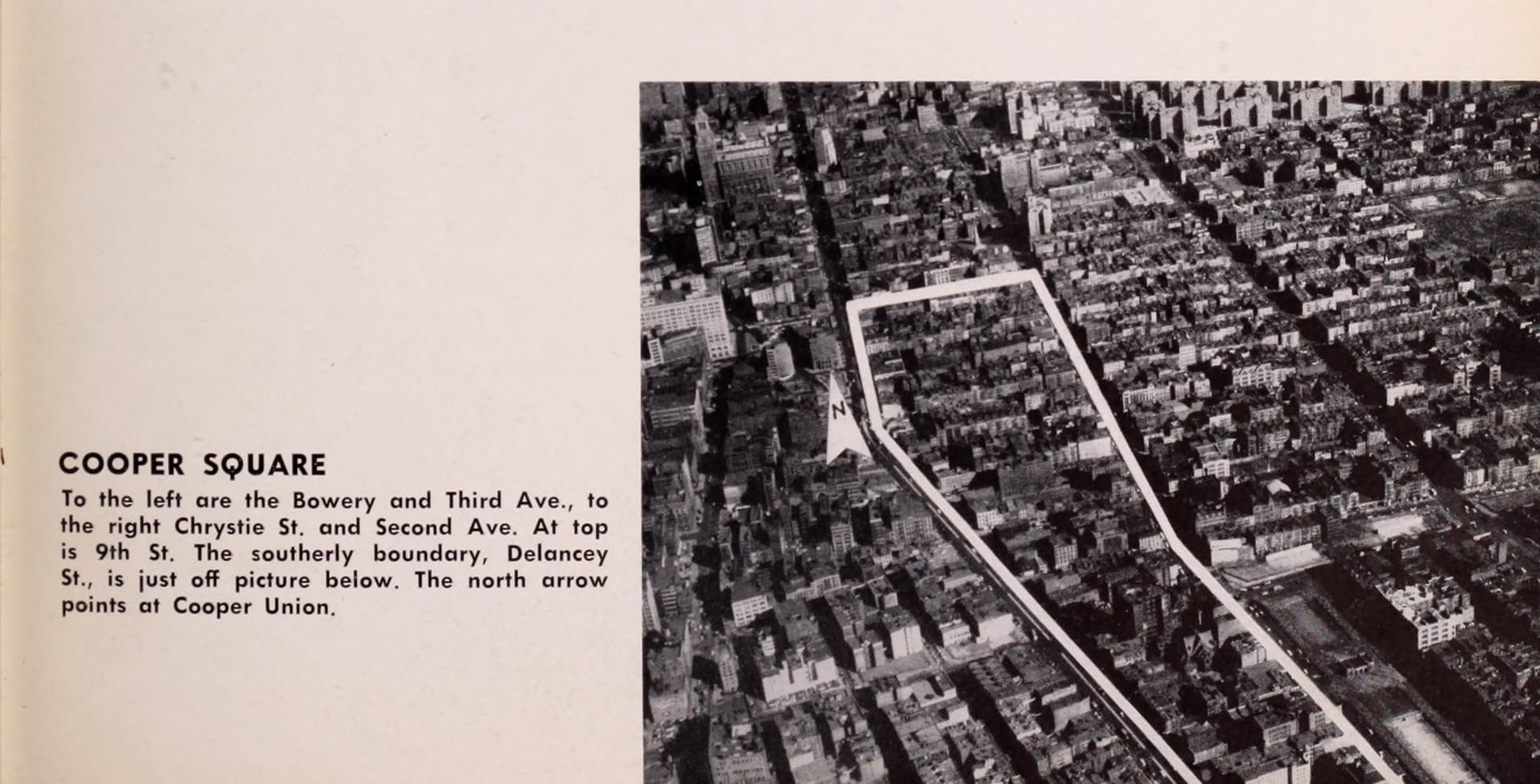
The Moses plan treated the neighborhood as surface rather than place. The proposal called for clearing every residential structure between the Bowery and Second Avenue, from Delancey Street on the south to East 9th Street on the north, a zone of twelve blocks.34 The Committee on Slum Clearance estimated that the demolition would displace approximately 2,400 families and thousands of additional men living in the single-room hotels, most of them low-income, working, and of the same ethnic communities that had occupied the blocks for two generations.25 Title I would have allowed the city to sell the cleared parcels to a private developer at a federal write-down price, and the site plan routed the payoff to new market-rate towers that the former residents could not have afforded to re-enter.
The procedural record was thin by design. Moses had, by 1959, presided over a decade of Title I clearances across the city, from West Side Urban Renewal to the blocks the Lincoln Center project removed at San Juan Hill. The Committee on Slum Clearance released its site selection reports as glossy brochures with few figures and almost no consultation with the people the plan displaced. The Cooper Square brochure followed that pattern. The residents read the proposal as a directive rather than an invitation, and they had two months before the city’s scheduled public hearing to produce a response.1
The Cooper Square Committee, November 1959
Organizing began within weeks of the brochure’s release. Frances Goldin, a tenant organizer then in her mid-thirties, had already spent five years on housing campaigns with the Lower East Side Neighborhoods Association and the newly founded Metropolitan Council on Housing.67 Thelma Burdick came out of the Church of All Nations settlement house on Second Avenue and brought the institutional relationships the settlement had built across half a century on the block. Esther Rand, a veteran of the Met Council, carried a decade of tenant-law experience into the new coalition. Walter Thabit, a young planner working independently in the city, attached himself to the Committee as its planning consultant and refused to take a fee the residents could not afford.89
The Cooper Square Committee held its founding meeting in November 1959. The coalition combined tenant organizers, artists, local clergy, shopkeepers along the Bowery and Second Avenue, and settlement-house social workers. The Church of All Nations, the Most Holy Redeemer parish, the Hamilton-Madison House, and St. Mark’s-in-the-Bowery contributed meeting rooms and staff. Cooper Union students and faculty volunteered architectural and survey work. The artists the city had not yet priced out of the neighborhood, many of them veterans of the Tenth Street galleries a few blocks north, contributed flyers, posters, and a constant stream of demonstrations that the newspapers covered.24
Goldin became the Committee’s public face. The Gotham Center for New York City History has described her posture in the early campaign as one of refusal to accept the premise of displacement as an unavoidable cost of new housing.1 The Committee adopted a guiding principle early in its work: any plan that left fewer low-income residents in Cooper Square than the plan found there was not a plan the neighborhood would accept. The principle ruled out not only the Moses proposal but every variant the city later offered that reduced the on-site low-income count.
The Alternate Plan, 1961
The Committee decided, within its first six months, to answer the Moses brochure with a plan of its own. Walter Thabit led the planning work. The Committee ran over one hundred community meetings through 1960 and into 1961 on the blocks the plan covered, and the meetings produced the survey data, the household counts, and the priority list that went into the document.93
The result, published in 1961 as An Alternate Plan for Cooper Square, proposed a different theory of renewal. The document preserved the existing occupied housing wherever the building stock allowed. It added new low-income and moderate-income housing on the vacant lots and on the parcels where demolition had already occurred. It gave every displaced site tenant priority for the new units. It staged the construction so that no household had to leave the neighborhood during the work. It held rents at levels the existing residents could pay. It proposed that the land under the new buildings remain under community rather than developer control.9
The Alternate Plan was the first document in the United States in which a neighborhood, rather than a city agency or a private developer, produced a full urban-renewal plan for its own land.510 Thabit later wrote that the document’s innovation lay not in any single architectural or financing mechanism but in the authorship. The people who would live with the plan had written it.11
The City Planning Commission rejected the Alternate Plan in 1961. The rejection was formal. The commission treated the document as an advocacy brief rather than a planning instrument and declined to take it up as the Committee’s official response to the city’s own proposal. The Committee’s members read the rejection as a procedural move and kept organizing. Goldin, Burdick, Rand, and the block captains the Committee had recruited on each of the twelve blocks went back to their neighbors and made the case that a ten-year fight was preferable to a one-year clearance.12
Cooper Square sits at the eastern edge of the East Village and the northern edge of the Lower East Side. Robert Moses announced a Title I urban-renewal plan for the area in 1959 that would have demolished twelve blocks, displaced approximately 2,400 low-income residents, and handed the cleared land to a private developer. Residents, artists, and clergy founded the Cooper Square Committee in November 1959, and the Committee fought the plan for a decade. The City Planning Commission approved a modified version of the Committee's own plan on January 7, 1970. The Committee converted the victory into the Cooper Square Community Land Trust, which still owns the land under twenty-one buildings containing more than three hundred units of permanently affordable housing.
The map shows Cooper Square study area, Moses Title I plan, 1959 (never executed), Alternate Plan for Cooper Square, adopted 1970, Cooper Square Community Land Trust holdings, and Cooper Square Mutual Housing Association cooperatives.
- Cooper Square study area
- Moses Title I plan, 1959 (never executed)
- Alternate Plan for Cooper Square, adopted 1970
- Cooper Square Community Land Trust holdings
- Cooper Square Mutual Housing Association cooperatives
Urban Renewal Atlas, illustrative study area.; Mayor's Committee on Slum Clearance 1959 designation.; Cooper Square Committee Alternate Plan, adopted January 7, 1970.; Illustrative cluster of the twenty-plus CLT buildings.; Tenant-run limited-equity cooperatives..
A decade of refusal
The fight from 1961 through 1969 produced no single dramatic hearing and no single newspaper headline that settled the matter. The Committee fought the plan one procedural step at a time. A succession of mayors and urban-renewal administrators proposed variants of the Moses clearance and then withdrew them. Each variant reduced the on-site low-income count. Each withdrawal came after a round of hearings, demonstrations, and negotiating sessions the Committee organized.24
The tactics ranged from the conventional to the theatrical. The Committee flooded public hearings with residents, filled the City Planning Commission chambers for every scheduled vote on the area, and filed written objections at every administrative deadline. The tenant organizers canvassed the SRO hotels and produced evidence that contradicted the city’s household counts. The Committee’s lawyers challenged the Title I designation on procedural grounds whenever a reviewable decision came up.
In 1965, the Committee ran what it called the Warpath campaign. Residents and supporters built wigwam camps on Chrystie Street and covered City Hall in feather-decorated postcards, each one bearing a variant of the Committee’s position that the blocks were not for sale.4 The imagery relied on a 1960s idiom that a present-day organizer would not choose, and the Cooper Square historians who write about the campaign note the dated framing. The tactical point, visible to everyone who watched the city through that winter, was that the Committee had sustained the fight for six years without losing either its members or the block organization the plan had threatened to dissolve.
The Lindsay administration arrived in 1966 and, after two years of delay, took up a serious negotiation with the Committee. The new Housing and Development Administration under Jason Nathan recognized that no Title I plan could pass through the Cooper Square blocks without the Committee’s agreement. The negotiations produced a modified version of Thabit’s Alternate Plan as the official city plan for the area.95
The City Planning Commission formally adopted the modified Alternate Plan on January 7, 1970.84 The commission’s vote meant that the first urban-renewal plan in the United States written by a neighborhood had replaced a city-written plan at the planning-commission level. The decision left the twelve blocks standing. It kept most of the SRO population in place. It set aside every vacant and cleared parcel for low-income and moderate-income construction. It built into city policy the staging rules and the tenant-priority rules the Committee had written nine years earlier.
From a victory to a land trust
The 1970 approval was the political victory, not the physical one. The Committee had won the right to determine the future of the blocks. Building what the Alternate Plan described took another two decades.
The 1970s were the decade of New York’s fiscal near-collapse. Federal urban-renewal money dried up. The blocks the Alternate Plan had slated for new construction sat vacant, burned, or stood half-occupied through the city’s worst financial years. The Committee converted its organizing into operating work. Residents took over tax-delinquent buildings, formed tenant associations on every parcel the Committee had fought for, and pushed the city to release the cleared lots under site-control agreements that preserved the Alternate Plan’s low-income requirement.23
The Koch administration began funding the scattered-site construction in the 1980s. The buildings went up on the vacant parcels through the late 1980s and into the 1990s under a patchwork of city programs that kept rents below market level. The existing buildings the Alternate Plan had preserved passed into tenant-run limited-equity cooperatives as the city transferred the buildings it had taken for back taxes.
The Cooper Square Committee filed incorporation papers for the Cooper Square Mutual Housing Association on June 28, 1991. A New York State Supreme Court judge approved the filing on August 15, 1991.12 The Mutual Housing Association took operational control of the buildings the Alternate Plan had preserved and the new buildings the city had funded on the cleared parcels. The state attorney general recognized the MHA as a limited-equity cooperative in 2012.12 Residents buy shares in the cooperative at low prices and sell them back at a formula price that keeps the apartments affordable to the next low-income household.
The Cooper Square Community Land Trust holds the land under the cooperative’s buildings. The Trust operates as a separate legal entity with a board that includes residents of the buildings and representatives of the wider Lower East Side community. The Trust cannot sell the land. The cooperative cannot sell the land. Every resale passes through the Trust’s affordability formula, which prevents any party from converting the equity the residents built into market-rate equity that the next generation could not enter.313
The Trust now holds the land under more than twenty buildings, containing over three hundred units of permanently affordable housing.313 The Cooper Square Community Land Trust is one of the longest-lived community land trusts in the United States and the one with the clearest direct lineage to a community-written urban-renewal plan.
Frances Goldin, the Committee, and the record
Goldin organized Cooper Square from 1959 until her death on May 16, 2020, at the age of 95, in the apartment on East 11th Street where she had lived for most of her adult life.1014 The New York Times obituary by Sam Roberts described her as an advocate for affordable housing and a staunch defender of the poor and quoted the phrase Goldin used about herself, an unreconstructed socialist.1415 She ran the Cooper Square Committee meetings, she testified at the city’s hearings, she stood in the street when the organizers needed a body in the street, and she outlived almost every urban-renewal official who had tried to clear her blocks.
Her second career, beginning in 1977, was as a literary agent. The Frances Goldin Literary Agency represented Mumia Abu-Jamal, Barbara Kingsolver, Adrienne Rich, Juan Gonzalez, Susan Brownmiller, Frances Fox Piven, and dozens of other writers whose politics most commercial agents refused to touch.6 In 2014, she co-edited Imagine: Living in a Socialist U.S.A. with Debby Smith and Michael Steven Smith, an anthology of essays on what a democratic socialist United States could look like.16 The book stood as a companion to the Cooper Square project, a written argument for the same principle the Alternate Plan expressed in housing, that working people could design the communities in which they lived.
The archival record of the fight lives at New York University’s Tamiment Library, which holds the Cooper Square Committee Records as collection TAM.356 and the related Marci Reaven Research Files as collection TAM.724.1718 The collections run from 1959 into the 2000s and contain the Committee’s correspondence, the planning materials, the minutes of the block organizations, the Warpath campaign files, the negotiating papers from the Lindsay administration, and the operational records of the buildings. The Cooper Square Committee, now operating as a neighborhood housing organization under a new generation of leadership, continues to organize at 59 East 4th Street, a block north of the blocks the Alternate Plan saved.2
What Cooper Square transferred to the present
The reason an atlas of urban renewal needs the Cooper Square record is not only that the Committee won. The reason is that the Committee won in a form that survives and that teaches. Four pieces of the Cooper Square method transfer almost unchanged to present-day fights over displacement, whether the pressure comes from private redevelopment, from state infrastructure projects, or from the data-center expansions now reshaping exurban counties across the United States.
The first is the principle of refusal. The Committee decided, at its founding, that no plan that reduced the on-site low-income count was acceptable. The principle gave the Committee a simple test it could apply to every city proposal across a decade of negotiation. Present-day coalitions facing displacement gain the same clarity when they set the standard at the outset, rather than accepting a premise the opposing party has written.
The second is authorship. The Alternate Plan was a real plan, with surveys, financing proposals, and architectural detail. The document answered the city on the city’s own terms and removed the argument that the community had nothing constructive to offer. The present-day equivalents include the Participatory Budgeting work in the Bronx and Queens, the community master plans the East Harlem coalition produced during the 2017 rezoning, and the counter-proposals that tenant groups have produced during the 2024 and 2025 Gowanus and Atlantic Avenue rezonings. Authorship takes more labor than opposition and produces a more durable outcome.
The third is duration. The Cooper Square Committee sustained the fight from November 1959 to January 1970 and then continued the operational work from 1970 to 1991 and from 1991 to the present. The Committee’s members understood, from the first meeting, that an urban-renewal plan could not be defeated in a single hearing. Present-day fights against data-center siting, highway expansions, and corporate redevelopment benefit from the same assumption. The wins arrive at the end of a decade of refusal, not at the end of a single meeting.
The fourth is ownership. The final form of the Cooper Square victory is the community land trust. The Committee converted a political win into durable ownership of the land. The Trust removes the parcels from the speculative market, which is the mechanism through which almost every other urban-renewal victory of the 1960s and 1970s eventually eroded. The Dudley Street Neighborhood Initiative in Boston, the Chicago Community Land Trust, and the growing network of CLTs across the United States have drawn on the Cooper Square model either directly or through the intermediate generation of practitioners the Cooper Square Committee trained. The model translates to rural counties as well as urban neighborhoods. A CLT can hold farmland, small-town main streets, or the parcels that a data-center developer would otherwise consolidate.
The Moses plan for Cooper Square would have cleared the blocks and handed them to a developer. The Cooper Square residents kept the blocks, wrote the plan, won the vote, held the land, and built the institution that holds the land still. Sixty-seven years after the founding meeting, the twenty-one buildings on the Cooper Square Community Land Trust stand as the physical record of a neighborhood that refused to accept displacement as a condition of renewal. The record is available. The method is reproducible. The work continues.
Footnotes
-
Gotham Center for New York City History, “Frances Goldin and the Moses Threat to Cooper Square.” https://www.gothamcenter.org/blog/goldin-coopersquare-zy4la-cerc4-ezwep-hsfs3s-rnyg3 ↩ ↩2 ↩3 ↩4
-
Cooper Square Committee, “Our Historical Accomplishments.” https://coopersquare.org/about-us/our-historical-accomplishments ↩ ↩2 ↩3 ↩4 ↩5 ↩6 ↩7
-
Cooper Square Community Land Trust, “Our Story,” 2024. https://www.coopersquareclt.org/our-story ↩ ↩2 ↩3 ↩4 ↩5
-
Bedford + Bowery, “‘Cooper Square Is Here to Stay,’ But First They Had to Go On the Warpath,” January 2015. https://bedfordandbowery.com/2015/01/cooper-square-is-here-to-stay-but-first-they-had-to-go-on-the-warpath/ ↩ ↩2 ↩3 ↩4 ↩5
-
Gotham Gazette, “The Anti-Moses And The First Community-Based Plan.” https://www.gothamgazette.com/index.php/development/2818-the-anti-moses-and-the-first-community-based-plan ↩ ↩2 ↩3
-
Frances Goldin, Wikipedia. https://en.wikipedia.org/wiki/Frances_Goldin ↩ ↩2
-
Shelterforce, “Frances Goldin, Revolutionary, Organizer, Visionary, Friend, Joins the Ancestors at Age 95,” July 1, 2020. https://shelterforce.org/2020/07/01/frances-goldin-mother-grandmother-revolutionary-neighbor-organizer-visionary-friend-joins-the-ancestors-at-age-95/ ↩
-
Mesa Refuge, “Walter Thabit.” https://mesarefuge.org/people/walter-thabit/ ↩ ↩2
-
Cooper Square Community Development Committee and Businessmen’s Association, An Alternate Plan for Cooper Square, prepared by Walter Thabit, 1961. Internet Archive digitization. https://archive.org/details/alternateplanfor00coop ↩ ↩2 ↩3 ↩4
-
New York Preservation Archive Project, “Frances Goldin and the Moses Threat to Cooper Square.” https://www.nypap.org/frances-goldin-and-the-moses-threat-to-cooper-square/ ↩ ↩2
-
Walter Thabit, How East New York Became a Ghetto, NYU Press, 2003. ↩
-
Cooper Square Mutual Housing Association, “History of the Cooper Square Mutual Housing Association (Formed in 1991).” http://csmha.org/wordpress/about-us/history-of-the-cooper-square-mutual-housing-association-formed-in-1991/ ↩ ↩2
-
RioOnWatch, “The Cooper Square Community Land Trust on the Lower East Side: A Model of Community Planning, Power and Tenure Since the 1960s.” https://rioonwatch.org/?p=78650 ↩ ↩2
-
The Lo-Down, “Remembering Frances Goldin, A Fearless Fighter For Affordable Housing,” May 2020. https://www.thelodownny.com/leslog/2020/05/remembering-frances-goldin-a-fearless-fighter-for-affordable-housing.html ↩ ↩2
-
BELatina, “Remembering Frances Goldin, Lower East Side Activist Who Gave a New Voice to the Forgotten Intellectuals,” 2020. https://belatina.com/remembering-frances-goldin-new-york-activist/ ↩
-
Frances Goldin, Debby Smith, and Michael Steven Smith, editors, Imagine: Living in a Socialist U.S.A., Harper Perennial, 2014. ↩
-
New York University, Tamiment Library and Robert F. Wagner Labor Archives, Cooper Square Committee Records, TAM.356. https://findingaids.library.nyu.edu/tamwag/tam_356/ ↩
-
New York University, Tamiment Library and Robert F. Wagner Labor Archives, Marci Reaven Research Files on the Cooper Square Committee, TAM.724. ↩
Sources
Cooper Square Community Land Trust. (2024). "Our Story".
https://www.coopersquareclt.org/our-storyFounded on the neighborhood plan the Cooper Square Committee won from the city in 1970. Holds the land under more than twenty low-income buildings on the Lower East Side.
NYU Tamiment Library and Robert F. Wagner Labor Archives. (2023). "Cooper Square Committee Records, TAM.356".
https://findingaids.library.nyu.edu/tamwag/tam_356/Organizational records of the Cooper Square Committee, 1959 through the 2000s. Correspondence, planning files, block organization minutes, Warpath campaign materials, negotiating papers, and operational records.
NYU Tamiment Library and Robert F. Wagner Labor Archives. (2023). "Marci Reaven Research Files on the Cooper Square Committee, TAM.724".
Secondary research files compiled by Marci Reaven on Cooper Square, the Lower East Side, and Frances Goldin.
Cooper Square Committee. (2023). "Our Historical Accomplishments".
https://coopersquare.org/about-us/our-historical-accomplishmentsTimeline of the Committee's work from founding in November 1959 through the present.
Cooper Square Community Development Committee and Businessmen's Association. (1961). "An Alternate Plan for Cooper Square".
https://archive.org/details/alternateplanfor00coopPrepared by Walter Thabit, planning consultant. First community-authored urban-renewal plan in the United States.
Walter Thabit. (2003). "How East New York Became a Ghetto". New York: NYU Press.
Foreword by Frances Fox Piven. Thabit reflects on his decades of advocacy planning, including the Cooper Square Alternate Plan.
Mesa Refuge. (2013). "Walter Thabit".
https://mesarefuge.org/people/walter-thabit/Biographical sketch of Walter Thabit. Records City Planning Commission approval of modified Alternate Plan on January 7, 1970.
Gotham Center for New York City History. (2022). "Frances Goldin and the Moses Threat to Cooper Square".
https://www.gothamcenter.org/blog/goldin-coopersquare-zy4la-cerc4-ezwep-hsfs3s-rnyg3New York Preservation Archive Project. (2021). "Frances Goldin and the Moses Threat to Cooper Square".
https://www.nypap.org/frances-goldin-and-the-moses-threat-to-cooper-square/Wikipedia. (2024). "Frances Goldin".
https://en.wikipedia.org/wiki/Frances_GoldinShelterforce. (2020). "Frances Goldin, Revolutionary, Organizer, Visionary, Friend, Joins the Ancestors at Age 95".
https://shelterforce.org/2020/07/01/frances-goldin-mother-grandmother-revolutionary-neighbor-organizer-visionary-friend-joins-the-ancestors-at-age-95/The Lo-Down. (2020). "Remembering Frances Goldin, A Fearless Fighter For Affordable Housing".
https://www.thelodownny.com/leslog/2020/05/remembering-frances-goldin-a-fearless-fighter-for-affordable-housing.htmlCites the New York Times obituary by Sam Roberts, which called Goldin an unreconstructed socialist and a staunch defender of the poor.
BELatina. (2020). "Remembering Frances Goldin, Lower East Side Activist Who Gave a New Voice to the Forgotten Intellectuals".
https://belatina.com/remembering-frances-goldin-new-york-activist/(2014). "Imagine: Living in a Socialist U.S.A.". New York: Harper Perennial.
Bedford + Bowery. (2015). "Cooper Square Is Here to Stay, But First They Had to Go On the Warpath".
https://bedfordandbowery.com/2015/01/cooper-square-is-here-to-stay-but-first-they-had-to-go-on-the-warpath/Account of the 1965 Warpath campaign on Chrystie Street.
Gotham Gazette. (2010). "The Anti-Moses And The First Community-Based Plan".
https://www.gothamgazette.com/index.php/development/2818-the-anti-moses-and-the-first-community-based-planCooper Square Mutual Housing Association. (2020). "History of the Cooper Square Mutual Housing Association (Formed in 1991)".
http://csmha.org/wordpress/about-us/history-of-the-cooper-square-mutual-housing-association-formed-in-1991/Records June 28, 1991 incorporation and 2012 state attorney general recognition as a limited-equity cooperative.
RioOnWatch. (2022). "The Cooper Square Community Land Trust on the Lower East Side: A Model of Community Planning, Power and Tenure Since the 1960s".
https://rioonwatch.org/?p=78650Kelly Anderson. (2022). "Rabble Rousers: Frances Goldin and the Fight for Cooper Square".
https://www.rabblerousersdoc.com/Documentary film on Frances Goldin and the Cooper Square Committee.