African-American
Brownsville
The city moved displaced families from Manhattan and the Bronx to Brownsville through the postwar decades, built eighteen NYCHA complexes in one square mile, and later displaced Brownsville residents in turn at Prospect Plaza.
1945–2009
Two displacements, one neighborhood
Brownsville sits in eastern Brooklyn on a roughly rectangular plat bounded by Eastern Parkway on the north, East 98th Street and Ralph Avenue on the west, Linden Boulevard on the south, and Van Sinderen Avenue on the east.1 The neighborhood covers about one square mile. Within the square, the New York City Housing Authority owns eighteen public housing developments, the largest concentration of public housing in the United States, with roughly ten thousand apartments in more than one hundred buildings.2 The density of public housing is the defining physical fact of Brownsville, and the density reflects two distinct waves of displacement that ran through the middle decades of the twentieth century.
The first wave ran from outside Brownsville into the neighborhood. From the late 1940s through the 1960s, the city used Brownsville as a relocation destination for the families whom three programs had displaced: the Cross Bronx Expressway, the Lincoln Square urban-renewal project around what is now Lincoln Center, and a wider slum-clearance program that moved Black and Puerto Rican households systematically across borough lines. The city built eighteen NYCHA towers on the acreage the bulldozers cleared in Brownsville itself and opened the apartments to the households arriving from the projects under way elsewhere.3
The second wave ran inside Brownsville. At Prospect Plaza, a four-tower NYCHA complex at the northwest corner of the neighborhood, the city emptied the buildings in 2003, demolished them over the years that followed, and replaced them with a smaller mixed-income development the first of whose buildings opened in 2015 and whose final phase opened in 2017.4 The complex displaced roughly one thousand two hundred residents, each one of whom NYCHA promised a right of return.4 Far fewer than a thousand returned. The relocation destination, three generations on, produced its own relocation story.
The Jewish Brownsville, 1887 to 1950
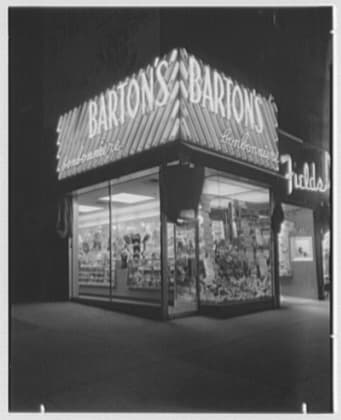
Elias Kaplan brought the first cluster of Jewish immigrants to Brownsville in 1887, when he built a small factory at the eastern edge of an otherwise rural stretch of New Lots and laid out housing for his workers near the corner of what is now Pitkin and Rockaway Avenues.5 The neighborhood filled rapidly with Russian and Polish Jewish immigrants crossing the Williamsburg Bridge after its opening in 1903. By 1908 the neighborhood held more than one hundred thousand residents, and by 1920 more than eighty thousand of the roughly one hundred thousand residents were Russian Jews.5 For the first half of the twentieth century, Brownsville was one of the densest Jewish neighborhoods in the United States.
The physical neighborhood reflected the community that built it. Walk-up brick apartment houses lined streets laid out at three-story density. Seventy Orthodox synagogues operated inside the one-square-mile footprint at the neighborhood’s peak, a concentration that earned Brownsville the nickname “Jerusalem of America.”6 Pitkin Avenue, Belmont Avenue, and Sutter Avenue held the commercial spine, with kosher groceries, Yiddish bookstores, and Jewish-owned delicatessens along the street wall. The Hebrew Educational Society opened a settlement house on Hopkinson Avenue in 1899. Yiddish dailies circulated in Brownsville households. Socialist and Communist party locals drew thousands of members, and Brownsville sent socialists to the State Assembly repeatedly through the 1920s. Margaret Sanger opened the first birth-control clinic in the United States at 46 Amboy Street in Brownsville in October 1916, a fact that reflects the neighborhood’s political character as much as the clinic’s own history.1
The Jewish Brownsville peaked in the late 1920s and began to thin through the Depression and the Second World War. The builders of the neighborhood had constructed walk-up tenements with few modern amenities, and the housing stock aged quickly. Second-generation and third-generation Jewish families, with the income to move, left Brownsville for Canarsie, Flatbush, and the new postwar subdivisions on Long Island through the 1940s and 1950s. The out-migration accelerated through the 1950s. By 1957 the Jewish population had fallen to an estimated seventy thousand, down from more than two hundred thousand at the peak, and by the mid-1960s the Jewish community of Brownsville had dispersed almost entirely.3
Wendell Pritchett’s Brownsville, Brooklyn: Blacks, Jews, and the Changing Face of the Ghetto remains the standard academic history of the transition. Pritchett documented the demographic shift in detail. Between 1940 and 1970 the population of Brownsville switched from roughly eighty-five percent white to roughly ninety-five percent Black and Puerto Rican.3 Pritchett’s argument, central to the revisionist history of the postwar American city, holds that a neighborhood collapse or a white-flight panic alone did not produce the shift in Brownsville. A deliberate housing policy produced the shift. The policy sorted Black and Puerto Rican households whom urban renewal had displaced into Brownsville while the city erased the neighborhoods where those households had lived previously.
The Cross Bronx, Lincoln Square, and the relocation pipeline
Robert Moses began construction on the Cross Bronx Expressway in 1948. The route ran seven miles across the South Bronx and required the demolition of apartment buildings along a continuous corridor through East Tremont, Morris Heights, and a band of other working-class neighborhoods. Robert Caro, in The Power Broker, estimated that the expressway displaced as many as sixty thousand Bronx residents between 1948 and the road’s completion in 1963, a figure later scholars have accepted with minor variation.7 The neighborhoods through which the road cut held racially integrated populations of Eastern European Jewish, Italian, and Irish immigrants, along with a growing number of Puerto Rican and African-American households who had arrived through the 1940s.
The city’s relocation policy for the displaced households ran through the New York City Housing Authority. The Housing Authority assigned many of the displaced families to public housing developments the city had under construction or had recently opened in other boroughs. The Housing Authority sorted the assignments racially in practice. Black and Puerto Rican households received priority for placement in developments in Brownsville, East New York, and the South Bronx itself. The Housing Authority more often placed white households from the same displaced block in Queens developments or in Manhattan projects with lower minority concentrations, and a substantial share simply left the public housing system and bought homes in the suburbs using Federal Housing Administration mortgages the agency refused to extend to Black or Puerto Rican applicants.3
The Lincoln Square urban-renewal project, which ran from the late 1950s through the mid-1960s and cleared the San Juan Hill neighborhood around what is now Lincoln Center, produced a second relocation pipeline into Brownsville. San Juan Hill had held one of the largest Black and Puerto Rican communities in Manhattan, and the project displaced more than seven thousand families. The Housing Authority placed a significant fraction of the displaced San Juan Hill families in Brownsville.3
The arithmetic of the placements built the Brownsville of the 1960s. The Brownsville Houses opened in 1948 on the block between Dumont and Livonia Avenues east of Stone Avenue, one of the first NYCHA developments the agency completed after the Second World War.2 The Van Dyke Houses, twenty-two buildings on a 22-acre parcel north of Livonia Avenue, opened in May 1955 with more than sixteen hundred apartments.8 The Tilden Houses, eight sixteen-story towers at Dumont and Rockaway Avenues, opened in June 1961.1 The Langston Hughes Apartments, three twenty-two-story towers on Sutter Avenue, opened in June 1968 with five hundred nine apartments.9 Prospect Plaza, at the northwest corner of the neighborhood on Sutter Avenue, opened in June 1974 with three hundred sixty-eight apartments in four towers.4 Fourteen other NYCHA developments opened in Brownsville between 1945 and the mid-1970s, and together the eighteen developments hold roughly ten thousand apartments in a single square mile.2
City policy, not statistical accident, produced the concentration. The Housing Authority chose the Brownsville sites because the land was cheaper than comparable parcels in other boroughs and because the neighborhood’s Jewish residents had begun to leave. The city cleared blocks of walk-up tenements, replaced them with towers, and assigned the towers to the households the same city’s urban-renewal bulldozers had displaced from Manhattan and the Bronx. The policy produced, by 1970, a neighborhood in which about ninety-five percent of residents were Black or Puerto Rican and in which roughly one-third of the housing stock belonged to the federal government through NYCHA.3
Brownsville occupies a roughly one-square-mile rectangle in eastern Brooklyn. Between 1945 and 1970 the city used the neighborhood as a relocation destination for families the Cross Bronx Expressway, Lincoln Square, and other urban-renewal projects displaced, and the Housing Authority built eighteen NYCHA complexes on the ground it cleared to receive those families. At Prospect Plaza, beginning in 2002, NYCHA relocated approximately fifteen hundred residents with a promise of right of return; the replacement housing opened in 2017, and only a fraction of the original households came back. The essay carries both the relocation-destination story and the displacement that followed.
The map shows Brownsville, one-square-mile, Brownsville Houses NYCHA, 1948, Van Dyke Houses NYCHA, 1955, Langston Hughes Apartments NYCHA, 1968, Prospect Plaza, demolished 2013 to 2014, Ocean Hill-Brownsville school district, 1967 to 1969, and Pitkin Avenue commercial spine.
- Brownsville, one-square-mile
- Brownsville Houses NYCHA, 1948
- Van Dyke Houses NYCHA, 1955
- Langston Hughes Apartments NYCHA, 1968
- Prospect Plaza, demolished 2013 to 2014
- Ocean Hill-Brownsville school district, 1967 to 1969
- Pitkin Avenue commercial spine
Urban Renewal Atlas, illustrative boundary.; Brownsville Houses NYCHA, 1948 onward.; Van Dyke Houses NYCHA, 1955 onward.; Langston Hughes Apartments NYCHA, 1968 onward.; Prospect Plaza site, NYCHA 1974 to 2014; replacement 2015 to 2017.; Community-control demonstration district.; Pitkin Avenue commercial corridor..
Ocean Hill-Brownsville, 1968
The relocation pipeline produced a set of political fights by the middle of the 1960s that ran on lines separate from the housing policy itself, the most consequential of which erupted over a school board. In 1967 the New York City Board of Education approved an experimental community-control demonstration for three districts, including the Ocean Hill-Brownsville district that spanned the northern edge of Brownsville and the southern edge of Bedford-Stuyvesant. The demonstration district elected a local governing board of Black and Puerto Rican parents, appointed a Black administrator named Rhody McCoy as unit superintendent, and in May 1968 moved to transfer thirteen teachers and six administrators, most of whom were white and Jewish, out of the district.10
The United Federation of Teachers, then led by Albert Shanker, responded with a citywide strike that began in September 1968 and ran, through three separate walkouts, for roughly thirty-six school days. At the height of the strike more than one million schoolchildren sat out of their classrooms. The strike ended in November 1968 on terms that favored the union. The demonstration district lost the staffing authority the Board of Education had extended to it, and within two years the state legislature had folded the community-control experiment into a thirty-two-district decentralization plan that preserved UFT seniority and due-process protections across the entire city school system.10
Jerald Podair’s The Strike That Changed New York remains the standard account of the confrontation. Podair argued that Ocean Hill-Brownsville produced a lasting rupture between Black community organizers and the overwhelmingly white, majority-Jewish teacher workforce and between Black and Jewish New York more broadly, a rupture the strike both exposed and widened.10 The fight over the schools is a distinct story from the housing-policy story of this essay, and the two stories do not map onto each other in a simple way. Pritchett has cautioned against the tendency to reduce the demographic history of Brownsville to a single narrative of interethnic conflict, a reduction the 1968 strike has sometimes encouraged in popular memory.3 Both histories run through the same neighborhood in the same decade, and a reader of one needs a reader’s grasp of the other.
The 1970s burn-down
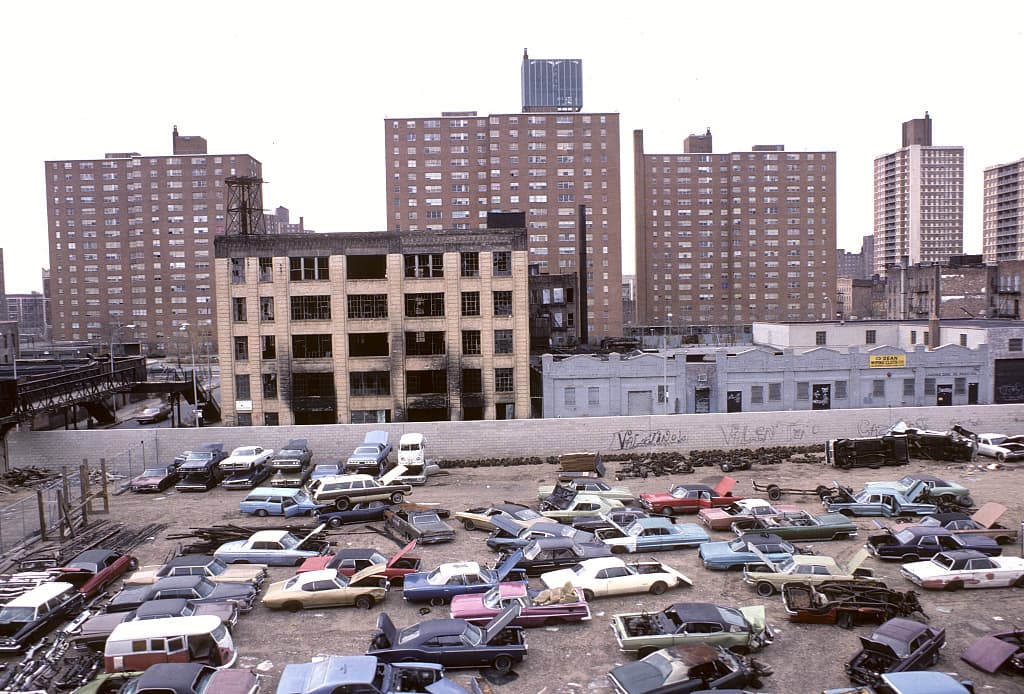
The housing-policy history and the political history together left Brownsville, by the early 1970s, with a rented housing stock outside the NYCHA developments that was old, small, and held almost entirely by absentee landlords. The fiscal crisis of 1975 cut city services across New York’s poorest neighborhoods. Sanitation pickups fell off, fire-company response times lengthened, and police patrols thinned. Landlords who had bought tenement blocks in the 1950s and 1960s, many of whom had mortgages they could no longer service against the rising tax arrears and the falling rents, began to withdraw maintenance. A fraction of the landlords in Brownsville, as in the South Bronx and a strip of other outer-borough neighborhoods, hired or inspired arsonists to set their own buildings on fire, collected insurance settlements, and walked away from the tax rolls.
The historian Jill Jonnes documented the same dynamic across the river in South Bronx Rising, the standard account of the 1970s burn-down. Jonnes estimated that the fires destroyed roughly eighty percent of the housing stock in the South Bronx over the decade and displaced more than a quarter million residents.11 Brownsville’s losses through the same decade were smaller than the Bronx’s in absolute terms, because NYCHA’s eighteen developments held much of the population in fire-resistant concrete buildings the landlords could not burn. The losses outside the projects were severe. Entire blocks of walk-up tenements along Sutter, Livonia, and Blake Avenues stood empty or burned through the late 1970s and early 1980s. The city acquired many of the burned parcels through tax foreclosure, and large sections of Brownsville’s streetscape remained vacant lots into the mid-1990s.1
The responsibility for the burn-down does not rest with the residents. Landlord disinvestment, federal redlining of mortgages and insurance, and the city’s withdrawal of municipal services combined to produce a housing market in which arson paid the property owner more than maintenance. Residents fought the fires by organizing tenant patrols, reporting absentee owners to the Department of Housing Preservation and Development, and pressing city agencies to take over the abandoned parcels. The campaigns had limited success during the fiscal crisis. They produced the tenant and advocacy networks that, a generation later, pushed back on the Prospect Plaza demolition.
Prospect Plaza, 2002 to 2017
Prospect Plaza opened in June 1974 at the northwest corner of Brownsville, on a block that Saratoga, Sutter, Howard, and Sterling bound. The complex held four towers of twelve and fifteen stories on five acres and contained three hundred sixty-eight apartments at opening.412 NYCHA ran the complex through the 1970s and 1980s. By the mid-1990s the four towers had fallen into severe disrepair, a consequence of deferred maintenance that tracked NYCHA’s citywide capital crisis rather than any failing particular to the complex.
In 2001 NYCHA announced a plan to vacate and renovate Prospect Plaza under the federal HOPE VI program and promised the residents a right of return to the renovated buildings.13 NYCHA began relocating residents in 2002 and completed the relocation by 2003.4 NYCHA later counted approximately one thousand one hundred seventy-two residents relocated; some press accounts describe the displaced population as approximately fifteen hundred.414 The scattered-site relocations moved families to NYCHA developments across Brooklyn and the rest of the city.
The renovation did not happen. In 2007 NYCHA determined that the HOPE VI framework could not finance the renovation of the towers and suspended the project. The four towers stood empty and weathered for the next seven years. In 2010 NYCHA and the Department of Housing Preservation and Development selected Blue Sea Development and a series of affordable-housing partners as the replacement development team. NYCHA demolished the first Prospect Plaza tower in 2013 and the remaining three in the summer of 2014.415 The replacement development broke ground the same year.
The first phase of the replacement, a building at 1855 Sterling Place with one hundred one apartments, opened in 2015. The second and third phases opened in 2016 and 2017. The combined replacement holds approximately two hundred eighty-four apartments, of which eighty belong to NYCHA as traditional public housing; rent restrictions cap the remainder at sixty percent of the Area Median Income.412
The replacement is smaller than the complex it replaced, and the right-of-return promise produced a thin return. NYCHA gave former Prospect Plaza residents priority placement for the eighty public housing units and lease-up preference for seventy of the affordable units, a combined pool of about one hundred fifty apartments against a displaced population of more than one thousand.14 NYCHA required returning residents in good standing and required credit checks for the non-public units, a screening pattern the tenant advocates who covered the project identified as a substantive departure from the unconditional right-of-return commitment NYCHA had made in 2001.14 No source publishes a precise final count of original residents who returned; available reporting and NYCHA’s own partial figures indicate a return rate well below half the displaced population.15
The Prospect Plaza history has become a reference case in New York housing policy, and the reference runs in both directions. For NYCHA, the project is a proof of concept the agency has cited in subsequent mixed-finance deals, including the Chelsea-Elliott-Fulton redevelopment the agency began planning in 2022.15 For tenant advocates and community organizers in Brownsville, the project is a warning: a right of return, without legal teeth and without a replacement unit count matched to the displaced unit count, does not bring displaced residents home.
The organizing record, 2010 to the present
Brownsville’s present-day organizing runs through institutions the community built after the burn-down and the Prospect Plaza decision. The Brownsville Community Justice Center, an operating program of the Center for Justice Innovation, opened in 2010 and works on criminal-justice reform, youth development, and commercial-corridor revitalization along Belmont and Pitkin Avenues. The community organizer Rosetta Gaston founded the Brownsville Heritage House, which the Stone Avenue branch of the Brooklyn Public Library now houses. The house collects oral histories, photographs, and memorabilia from the neighborhood’s Jewish, African-American, and Caribbean periods side by side.16 Community Board 16, the official advisory board for Brownsville and Ocean Hill, has pushed the Department of Housing Preservation and Development toward a neighborhood plan that the agency published in 2017 under the title At Home in Brownsville: A Plan for Transforming Public Housing.17
The 2017 plan is a substantive document. The report documented the eighteen NYCHA developments, the roughly ten thousand apartments, and the particular problems that flow from a concentration of public housing at the Brownsville scale: aging capital stock, limited street-level retail, severed sidewalk grids where NYCHA superblocks interrupt the commercial corridors, and a concentration of very-low-income households whose combined purchasing power cannot alone support the commercial life of the surrounding streets. The report proposed a set of interventions including capital reinvestment in the existing NYCHA buildings, targeted infill on underused NYCHA parcels rather than tower demolition, and ground-floor retail conversion along the projects’ street frontages.17
The plan’s central recommendation is worth reading against the Prospect Plaza history. The 2017 document explicitly rejected the demolition-and-replacement model the city used at Prospect Plaza and proposed, in its place, capital reinvestment in the existing NYCHA buildings combined with infill on parking lots and other underused parcels on the same campuses.17 The rejection is not a guarantee. NYCHA has not committed, as of 2024, to applying the infill-rather-than-demolition approach as the default standard across the city, and the agency’s Chelsea-Elliott-Fulton plan in Manhattan suggests the demolition model remains available to the planners. For Brownsville residents who watched the Prospect Plaza relocations of 2003, the infill approach is the organizing demand the community has won on paper and expects the agency to execute in practice.
Community organizers in Brownsville are explicit about the transfer. The lesson the Prospect Plaza residents, the tenant advocates who covered the case, and the organizers at the Brownsville Community Justice Center and Community Board 16 draw from the twenty-year history of the complex is specific and actionable. A right-of-return promise, written without a binding one-for-one replacement obligation and without pre-construction relocation funding that keeps the displaced households inside the neighborhood until they can return, produces the result Prospect Plaza produced. Community-led redevelopment, organizers argue, must begin with a binding unit count, an enforceable timeline, and an in-neighborhood holding strategy. Capital reinvestment in occupied buildings, where it is engineering-feasible, carries a fraction of the displacement risk of a full demolition. The At Home in Brownsville report is a partial codification of those organizing demands, and the next decade of NYCHA projects will test whether the agency applies the framework beyond a single report.
The Brownsville Heritage House’s work adds a second axis. Rosetta Gaston founded the Heritage House in 1974 to keep the record of the African-American and Caribbean community’s arrival and institution-building in the neighborhood, and the house’s collections now span the full arc from Elias Kaplan’s factory to the 1968 strike to the Prospect Plaza demolition. A community that holds its own record, in an institution the community built and runs, carries a practical advantage in the planning fights the 2017 report did not fully settle. Researchers, journalists, and organizers who need the oral histories of the Brownsville Houses in 1948, of the Van Dyke Houses in 1955, of Rhody McCoy’s school district in 1968, or of the Prospect Plaza right-of-return campaign can find them at the Stone Avenue library, together, in the neighborhood.16
Brownsville in 2026 remains what a century of housing policy made of the one-square-mile rectangle in eastern Brooklyn. The eighteen NYCHA developments still hold roughly ten thousand apartments and roughly one-third of the neighborhood’s housing stock. The demographic composition has stayed majority Black and Puerto Rican since the late 1960s, with a growing Caribbean and West African population through the 1990s and 2000s. Median household income runs among the lowest of any neighborhood in New York City, a fact the 2017 HPD report treated as the central planning challenge rather than as a fixed condition.17
The Prospect Plaza towers are gone. The replacement buildings, smaller in unit count and narrower in affordability range, sit on the old footprint. The displaced residents, most of whom did not return, scattered into other NYCHA developments in Brooklyn and Queens. The Brownsville Houses, the Van Dyke Houses, the Tilden Houses, the Langston Hughes Apartments, and the other fourteen NYCHA complexes remain. The tenant associations, the Community Board 16 offices, the Brownsville Community Justice Center, and the Brownsville Heritage House at Stone Avenue carry the organizing work forward.
The atlas of urban renewal in New York City carries Brownsville as a double case. The neighborhood is the one the city used to absorb the households it displaced from Manhattan and the Bronx in the middle decades of the twentieth century. The neighborhood is also the one the city then displaced in turn, at Prospect Plaza, beginning in 2002. The lesson the Brownsville organizers have drawn from their own double history, and the lesson the HPD report in 2017 partially codified, is that the concentration of public housing in a single neighborhood produced harms the city did not anticipate and a planning framework that depends on demolition-and-replacement compounds those harms rather than repairing them. The framework the community has proposed in the place of demolition, capital reinvestment in occupied buildings plus infill on underused parcels, rests on the documented record of what the Prospect Plaza demolition did and did not deliver. The record exists because the Brownsville Heritage House, the tenant associations, the city archives, and the academic historians kept it.
Footnotes
-
Wikipedia, “Brownsville, Brooklyn.” https://en.wikipedia.org/wiki/Brownsville,_Brooklyn ↩ ↩2 ↩3 ↩4
-
New York City Office of the Mayor, “Changing the Narrative: Brownsville Houses Policy Brief,” 2019. https://map.cityofnewyork.us/wp-content/uploads/2019/01/Brownsville-Houses-Policy-Brief.pdf ↩ ↩2 ↩3
-
Wendell E. Pritchett, Brownsville, Brooklyn: Blacks, Jews, and the Changing Face of the Ghetto, University of Chicago Press, 2002. ↩ ↩2 ↩3 ↩4 ↩5 ↩6 ↩7
-
Wikipedia, “Prospect Plaza Houses.” https://en.wikipedia.org/wiki/Prospect_Plaza_Houses ↩ ↩2 ↩3 ↩4 ↩5 ↩6 ↩7 ↩8
-
Brooklyn Jewish Historical Initiative, “Brownsville: The Jewish Years.” https://brooklynjewish.org/explore-brooklyn/living-in-brooklyn-the-jewish-experience/brownsville-the-jewish-years/ ↩ ↩2
-
Brooklyn Jewish Historical Initiative, “Brownsville.” https://brooklynjewish.org/neighborhoods/brownsville-brooklyn/ ↩
-
Wikipedia, “Cross Bronx Expressway.” https://en.wikipedia.org/wiki/Cross_Bronx_Expressway ↩
-
New York City Housing Authority, “Van Dyke I: Development Fact Sheet.” https://www.nyc.gov/site/nycha/about/developments/brooklyn.page ↩
-
New York City Housing Authority, “Langston Hughes Apartments: Development Fact Sheet.” https://www.nyc.gov/assets/nycha/downloads/pdf/Hughes%20Apartments.pdf ↩
-
Jerald E. Podair, The Strike That Changed New York: Blacks, Whites, and the Ocean Hill-Brownsville Crisis, Yale University Press, 2002. ↩ ↩2 ↩3
-
Jill Jonnes, South Bronx Rising: The Rise, Fall, and Resurrection of an American City, Atlantic Monthly Press, 1986. ↩
-
New York City Housing Authority, “Prospect Plaza: Development Fact Sheet,” 2017. https://www.nyc.gov/assets/nycha/downloads/pdf/Prospect%20Plaza.pdf ↩ ↩2
-
City Limits, “Tower Wreckers,” July 2001. https://citylimits.org/2001/07/01/tower-wreckers/ ↩
-
Our Time Press, “NYCHA Development Being Privatized: Prospect Plaza Residents Need Credit Check to Move Back In.” https://ourtimepress.com/nycha-development-being-privatized-prospect-plaza-residents-need-credit-check-to-move-back-in/ ↩ ↩2 ↩3
-
City Limits, “As Chelsea Demo Plans Move Ahead, A Look Back to NYCHA’s Brooklyn Razing,” October 2023. https://citylimits.org/2023/10/12/as-chelsea-demo-plans-move-ahead-a-look-back-to-nychas-brooklyn-razing/ ↩ ↩2 ↩3
-
Brooklyn Public Library, “Stone Avenue Library and Brownsville Heritage House.” https://www.bklynlibrary.org/locations/stone-avenue ↩ ↩2
-
New York City Department of Housing Preservation and Development, At Home in Brownsville: A Plan for Transforming Public Housing, 2017. https://www.nyc.gov/assets/hpd/downloads/pdfs/services/brownsville-report.pdf ↩ ↩2 ↩3 ↩4
Sources
New York City Municipal Archives. (2023). "Department of Housing Preservation and Development Image Collection".
https://a860-collectionguides.nyc.gov/repositories/2/resources/102Documentation of urban-renewal projects across the five boroughs.
Wendell E. Pritchett. (2002). "Brownsville, Brooklyn: Blacks, Jews, and the Changing Face of the Ghetto". Chicago: University of Chicago Press.
Jerald E. Podair. (2002). "The Strike That Changed New York: Blacks, Whites, and the Ocean Hill-Brownsville Crisis". New Haven: Yale University Press.
Jill Jonnes. (1986). "South Bronx Rising: The Rise, Fall, and Resurrection of an American City". New York: Atlantic Monthly Press.
Wikipedia. (2024). "Brownsville, Brooklyn".
https://en.wikipedia.org/wiki/Brownsville,_BrooklynWikipedia. (2024). "Prospect Plaza Houses".
https://en.wikipedia.org/wiki/Prospect_Plaza_HousesNew York City Housing Authority. (2024). "Van Dyke I: Development Fact Sheet".
https://www.nyc.gov/site/nycha/about/developments/brooklyn.pageNew York City Housing Authority. (2024). "Langston Hughes Apartments: Development Fact Sheet".
https://www.nyc.gov/assets/nycha/downloads/pdf/Hughes\%20Apartments.pdfNew York City Housing Authority. (2017). "Prospect Plaza: Development Fact Sheet".
https://www.nyc.gov/assets/nycha/downloads/pdf/Prospect\%20Plaza.pdfNew York City Department of Housing Preservation and Development. (2017). "At Home in Brownsville: A Plan for Transforming Public Housing".
https://www.nyc.gov/assets/hpd/downloads/pdfs/services/brownsville-report.pdfNew York City Office of the Mayor. (2019). "Changing the Narrative: Brownsville Houses Policy Brief".
https://map.cityofnewyork.us/wp-content/uploads/2019/01/Brownsville-Houses-Policy-Brief.pdfCity Limits. (2001). "Tower Wreckers". City Limits.
https://citylimits.org/2001/07/01/tower-wreckers/City Limits. (2023). "As Chelsea Demo Plans Move Ahead, A Look Back to NYCHA's Brooklyn Razing". City Limits.
https://citylimits.org/2023/10/12/as-chelsea-demo-plans-move-ahead-a-look-back-to-nychas-brooklyn-razing/Our Time Press. (2016). "NYCHA Development Being Privatized: Prospect Plaza Residents Need Credit Check to Move Back In". Our Time Press.
https://ourtimepress.com/nycha-development-being-privatized-prospect-plaza-residents-need-credit-check-to-move-back-in/Brooklyn Jewish Historical Initiative. (2023). "Brownsville: The Jewish Years".
https://brooklynjewish.org/explore-brooklyn/living-in-brooklyn-the-jewish-experience/brownsville-the-jewish-years/Brooklyn Jewish Historical Initiative. (2023). "Brownsville".
https://brooklynjewish.org/neighborhoods/brownsville-brooklyn/BlackPast. (2020). "Brownsville, in Brooklyn, New York (1858-)".
https://blackpast.org/african-american-history/brownsville-in-brooklyn-new-york-1858/Brooklyn Public Library, Center for Brooklyn History. (2023). "Brownsville and East New York Photographs, 1958-1965".
https://www.bklynlibrary.org/brooklyncollection/finding-aid/brownsville-and-east-newWikipedia. (2024). "Cross Bronx Expressway".
https://en.wikipedia.org/wiki/Cross_Bronx_ExpresswayWikipedia. (2024). "1970s South Bronx Building Fires".
https://en.wikipedia.org/wiki/1970s_South_Bronx_building_firesBrooklyn Public Library. (2023). "Stone Avenue Library and Brownsville Heritage House".
https://www.bklynlibrary.org/locations/stone-avenueCenter for Justice Innovation. (2024). "Brownsville Community Justice Center".
https://www.innovatingjustice.org/programs/brownsville-community-justice-centerNew York Public Library. (2023). "Digital Tax Photographs of New York City, 1939-1941 and 1983-1988".
https://digitalcollections.nypl.org/collections/1940s-tax-department-photographs